

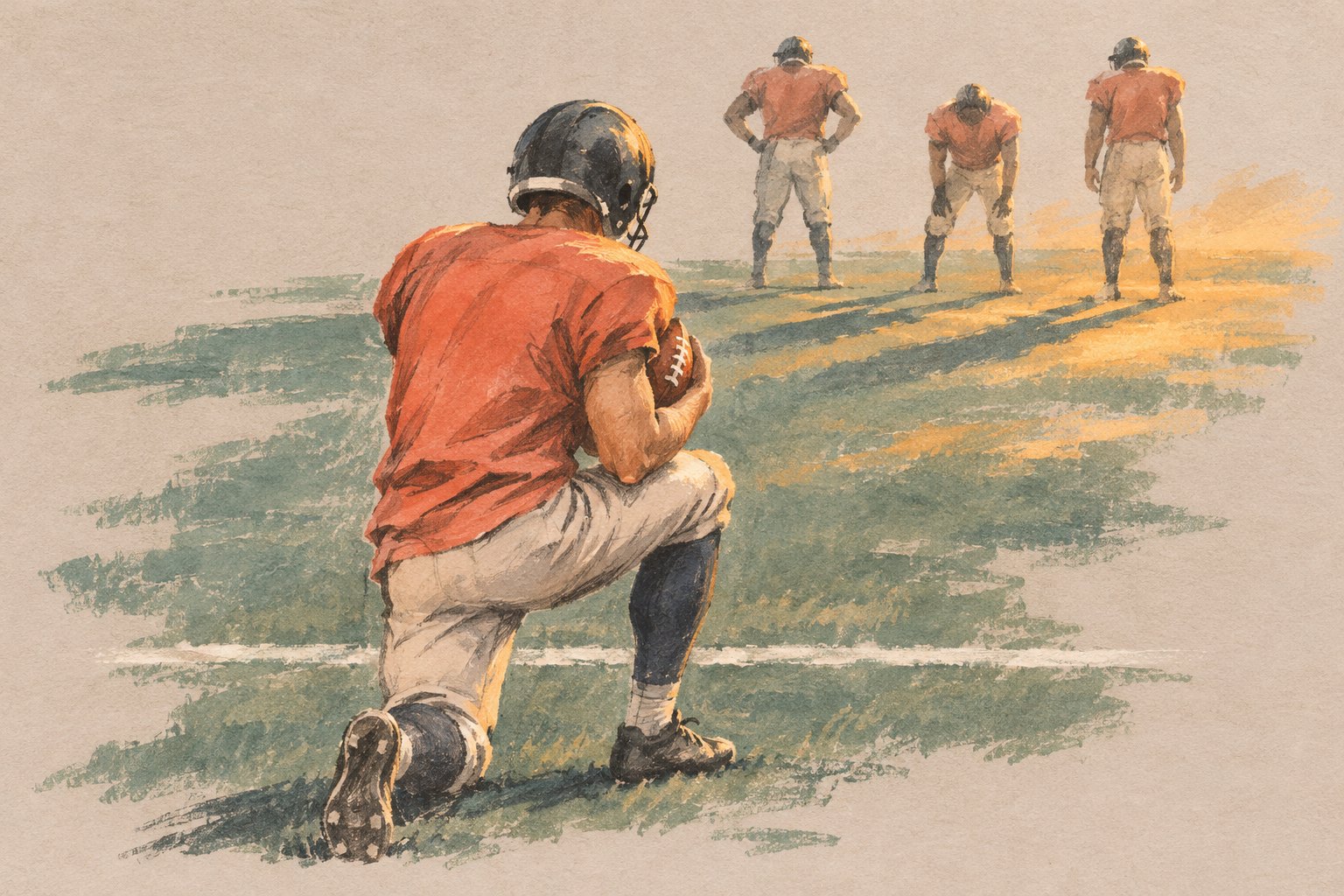
Yes, NFL kneel-downs can take yards off a quarterback’s rushing total. A scramble can add to that same total. A play officially recorded as a sack goes in a separate category.
That is why a rushing over can look home with a minute left and finish short. Read the player’s rushing row, keep the exact line beside it and wait for the last snap.
Match your ticket to the rushing row
Start with the named player and the period on the receipt. “Rushing yards,” “rushing attempts” and “longest rush” ask three different questions. Finding the right player is only the first step.
| Market | Number to follow | Example |
|---|---|---|
| Player rushing yards | Net rushing yards for that player | Five carries totaling 42 yards |
| Player rushing attempts | Credited carries | Five attempts |
| Player longest rush | Longest single credited run | A 19-yard run |
The 42 yards could come from runs of 19, 12, 8, 5 and minus 2. Counting carries tells you how often the player ran. It does not tell you the net yardage or the longest gain.
Find out whether the play was a run or a sack
A quarterback can gain rushing yards on a scramble or a designed run. Under the NFL’s scoring guidance, a loss while attempting to pass behind the line is recorded as a sack. A designed rushing play can instead lose rushing yards. The official classification matters when a broken play looks ambiguous. NFL Guide for Statisticians, Rushing and Passing and Sacks
For a hypothetical quarterback with 42 rushing yards, an eight-yard sack leaves the rushing total at 42. An eight-yard loss on a credited rushing play takes it to 34.
If you are checking the other side of the box score, our NFL passing-yards guide explains the difference between a quarterback’s passing yards and team net passing.
Keep watching when the victory formation appears
A kneel-down is a rushing play. In Super Bowl LIV, the official gamebook records Patrick Mahomes taking late knees for losses of five, three and seven yards. He finished with 29 rushing yards. The NFL also calculates rushing yardage by subtracting losses from gains. A late knee can therefore increase a quarterback’s attempts while reducing his yards. NFL Super Bowl LIV gamebook · NFL rushing-stat guidance
Hypothetical full-game NFL example
Two more carries. Three fewer yards.
- Before the final possession
- 5 attempts · 42 yards
- Two credited kneel-downs
- −1 yard and −2 yards
- Final rushing row
- 7 attempts · 39 yards
42 − 1 − 2 = 39. Assuming ordinary valid markets settled on those final stats, over 40.5 rushing yards loses. Over 6.5 rushing attempts wins.
The yard losses here are invented for the example. Read the credited gains and losses in the actual play-by-play instead of assuming every knee costs exactly one yard.
Compare the final total with the exact wording
Use that hypothetical 39-yard finish to read three possible tickets. A selection of 39+ reaches its target. Over 38.5 also clears. Over 39.5 falls short.
A whole-number over/under adds a tie question. For an ordinary two-way market with push rules, over 39 pushes at exactly 39 and the stake is returned. “39+” reaches its target at 39. Check the market’s equality rule before treating similar labels as interchangeable. Our guide to comparing prop lines walks through that difference with the price attached.
Keep the period and the house rules attached
The examples above assume full-game NFL player markets that have action. A first-half ticket uses its own window. A full-game ticket may include overtime under its applicable rules. For example, bet365 Pennsylvania’s player-betting page states an overtime-inclusive default unless otherwise specified. Participation and grading terms also apply. bet365 Pennsylvania player-betting rules
The Pennsylvania example describes that operator’s local rules. For your ticket, use the rules for the book and jurisdiction that accepted it. If an official count changes later, the sportsbook’s correction policy determines how that affects the grade. Our stat-correction explainer covers that next step.
BetSlip Live helps you keep supported player-prop progress together. Keep the receipt’s player, market and period beside the live count, then use the sportsbook’s final grade for the result.