

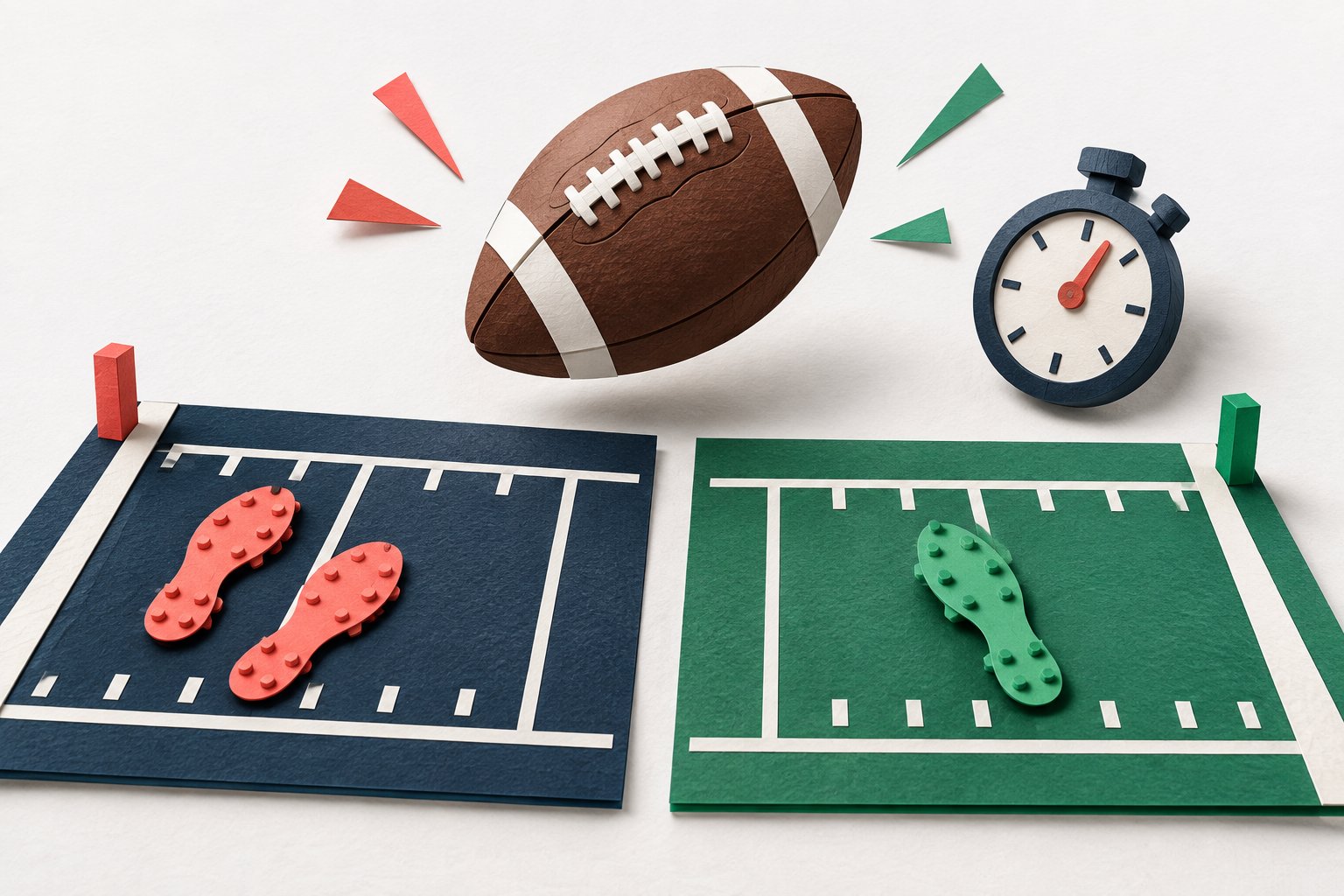
You spend Saturday watching a receiver land one foot inbounds. Touchdown. On Sunday, somebody makes almost the same grab. Incomplete. Suddenly you’re arguing with the television like it owes you an explanation.
It does. NFL and college football share the basics, but their rulebooks disagree on enough details to keep your group chat employed.
Our scope: the 2026 NFL season and NCAA Division I football, including FBS and FCS. Rules checked October 5, 2026. This is a fan’s guide to the main differences; penalty and replay situations can add exceptions.
The Saturday-to-Sunday cheat sheet
| Situation | NFL | College (Division I) |
|---|---|---|
| Sideline catch* | Two feet inbounds | One foot inbounds |
| Runner falls untouched | Usually can get up and continue | Down when a body part other than a hand or foot touches |
| First down inbounds | No routine first-down clock stop | Brief stop after the two-minute timeout in either half |
| Two-minute break | Two-minute warning | Two-minute timeout |
| Overtime | Timed extra period; regular season can end tied | Alternating series; two-point rounds from third OT |
| Defensive pass interference | Generally a spot foul | Generally spot foul up to 15 yards |
| Hash marks apart | 18 feet, 6 inches | 40 feet |
| Extra-point / two-point snap | 15-yard / 2-yard line | Normally 3-yard line for either |
*The feet are only part of completing a catch. Control and the rest of the catch process still matter. The sections below unpack the shortcuts in this chart.
1. One foot vs. two feet: the famous difference
College needs one foot inbounds. The NFL needs both feet—or another body part, such as a knee, inbounds. A hand by itself does not satisfy the NFL’s landing requirement. The white boundary is out of bounds.
Picture a receiver controlling the ball, planting a toe inside the sideline, and landing the other foot outside. That landing can work on Saturday. It doesn’t meet Sunday’s two-foot requirement.
But “one foot down” is not a magic spell. Both games require control and completion of the catch process. Going to the ground can still turn a spectacular grab into an incompletion. College gives the receiver a little more sideline room; it doesn’t abolish the replay debate.
Sources: NFL Rule 8-1-3; NCAA Rule 2-4-3.
2. In college, the turf can tackle you
A college ball carrier is down when a body part other than a hand or foot touches the ground. No defender needs to help. Slip, put a knee down, and the play is over. The grass gets the stop.
In the NFL, an untouched runner generally can get up and keep going. Giving yourself up, sliding, kneeling, and other dead-ball rules are exceptions. So if a pro receiver falls after a catch, the defense still has a very good reason to finish the play.
Sources: NFL Rule 7-2-1; NCAA Rule 4-1-3.
3. The clock has opinions—and they change by day
Both games have four 15-minute quarters. Both generally use a 40-second play clock after a normal play and a 25-second clock for specified administrative situations. The interesting differences are in when the game clock restarts.
First downs: retire the old college shortcut
“The clock always stops for a college first down” is outdated for Division I. Outside the late-half window, a routine first down inbounds keeps the clock running. After the two-minute timeout in either half, an offensive first down stops it briefly, then it restarts on the referee’s signal. That is a little breathing room, not a free team timeout.
The NFL has no equivalent routine pause just for gaining a first down. A measurement or another reason for a stoppage is a separate matter.
Out of bounds: watch the restart
A normal run out of bounds stops the clock in both games, but it doesn’t always stay stopped until the next snap.
- NFL: the clock normally restarts when the ball is ready. It waits for the snap after the first-half two-minute warning and inside the final five minutes of the second half.
- College: it normally restarts on the referee’s signal. After the two-minute timeout in either half, it waits for the snap.
Those are the normal runner-out-of-bounds cases; fumbles, possession changes, penalties, and other situations can change the administration. The practical lesson: stepping out with four minutes left in the fourth quarter buys different amounts of time.
College has a two-minute break now, too
The NFL calls it the two-minute warning. College calls it the two-minute timeout, introduced in 2024. Neither uses one of a team’s charged timeouts. Same chance to refill your drink, different name on the broadcast.
Halftime: more room for the marching band
The NFL rulebook sets a standard 13-minute halftime. College regular-season halftime is 20 minutes unless the schools agree beforehand to shorten it. Special-event schedules can differ. Either way, four 15-minute quarters do not mean you’ll be home in an hour.
Sources: NFL Rule 4; NCAA Rules 3-2 and 3-3; NCAA first-down timing change.
4. Overtime: two very different parties
NFL: more football, with a time limit
Regular-season overtime is one 10-minute period. Under the rules adopted in 2025, both teams ordinarily get an opportunity to possess—even after an opening-drive touchdown. But that opportunity is subject to the period ending. The clock can run out before the second team finishes, or even begins, its possession.
Once the initial opportunities are resolved, the score and sudden-death rules determine the winner. A defensive score can end things immediately; for example, a pick-six on the opening possession wins the game. If the score is tied when regular-season overtime expires, it stays a tie.
Playoff overtime uses 15-minute periods and continues as needed to produce a winner. There is no playoff tie. Your bedtime is not an official consideration.
College: start close, then get closer
College overtime has no running game clock, although the play clock still applies. Instead, teams take turns with the ball:
- First OT: each team starts a possession series at the opponent’s 25-yard line. A touchdown can be followed by a kick or a two-point attempt.
- Second OT: series still start at the 25, but a team scoring a touchdown must attempt two.
- Third OT onward: each team gets a single two-point try from the 3-yard line per round. Repeat until a round separates them.
A defensive touchdown during a possession series can end the game without another offensive series. Otherwise, the system gives the teams matching chances in a round.
Example: in third overtime, Team A converts and Team B doesn’t. Team A wins. If both convert—or both fail—everyone gets another serving of stress. A game labeled “6 OT” therefore isn’t six extra quarters of football.
Sources: NFL Rule 16; NFL’s overtime change; NCAA Rule 3-1-3.
5. Pass interference has a different price tag
In the NFL, defensive pass interference generally gives the offense the ball at the foul’s spot and an automatic first down. In college, it is generally a spot foul when it happens fewer than 15 yards downfield, or a 15-yard penalty when it happens farther away, also with a first down.
Imagine interference on a catchable pass 40 yards downfield, away from the goal line. Sunday’s flag can move the offense 40 yards. Saturday’s normally moves it 15. Same yellow laundry, very different delivery fee.
Near the goal line, special enforcement rules apply. And the college cap is not permission to tackle a receiver: separate personal fouls and other violations can bring additional consequences.
Sources: NFL Rule 8-5; NCAA Rule 7-3-8.
6. Same field size, different angles
The playing field is the same overall size: 100 yards between goal lines, plus two 10-yard end zones, and 53⅓ yards wide. The hash marks are where the geometry changes.
College hashes are 40 feet apart; NFL hashes are 18 feet, 6 inches apart. When the ball is spotted on a college hash, there is a bigger difference between the short side and the wide side of the field.
That gives offenses different spacing to work with and can create sharper kicking angles. The wider side isn’t just more grass. It’s more room for a coach to draw arrows.
Sources: NFL field specifications; NCAA Rule 1 and field diagram.
7. Even the extra point moves
Normally, college snaps both the extra-point kick and the two-point try from the 3-yard line. The NFL snaps the kick from the 15, but a run or pass for two from the 2.
The snap spot is not the kick’s distance: add the end zone and the holder’s depth. That’s why a normal NFL extra point is about a 33-yard kick, while college’s is about 20 yards. “Automatic” remains a dangerous word to say while your kicker is lining up.
Sources: NFL Rule 11-3; NCAA Rule 8-3-2.
Why Saturday and Sunday feel different
The rules help explain the rhythm. College offers more sideline margin for catches, wider hash spacing, a late-half first-down pause, and overtime built around short-field chances. The NFL asks for tighter sideline footwork and uses overtime that still looks like a drive down a full field.
There’s also the human part: college matches programs with very different rosters and levels of experience; the NFL brings together players who made it through that filter. That can make the strategy and feel different even before anyone throws a flag.
Keep three reminders handy: count the feet, check the clock, and know which overtime you’re watching. You’ll understand more of the game—and at least one group-chat argument will become your moment.
Official sources and rule check
Researched October 5, 2026 using the 2026 NFL rulebook and the NCAA’s official football rules resources, including its linked 2026 rules book. The college clock comparison here is for Division I. Source links appear beside the relevant explanations so you can settle the argument with the actual rulebook.